
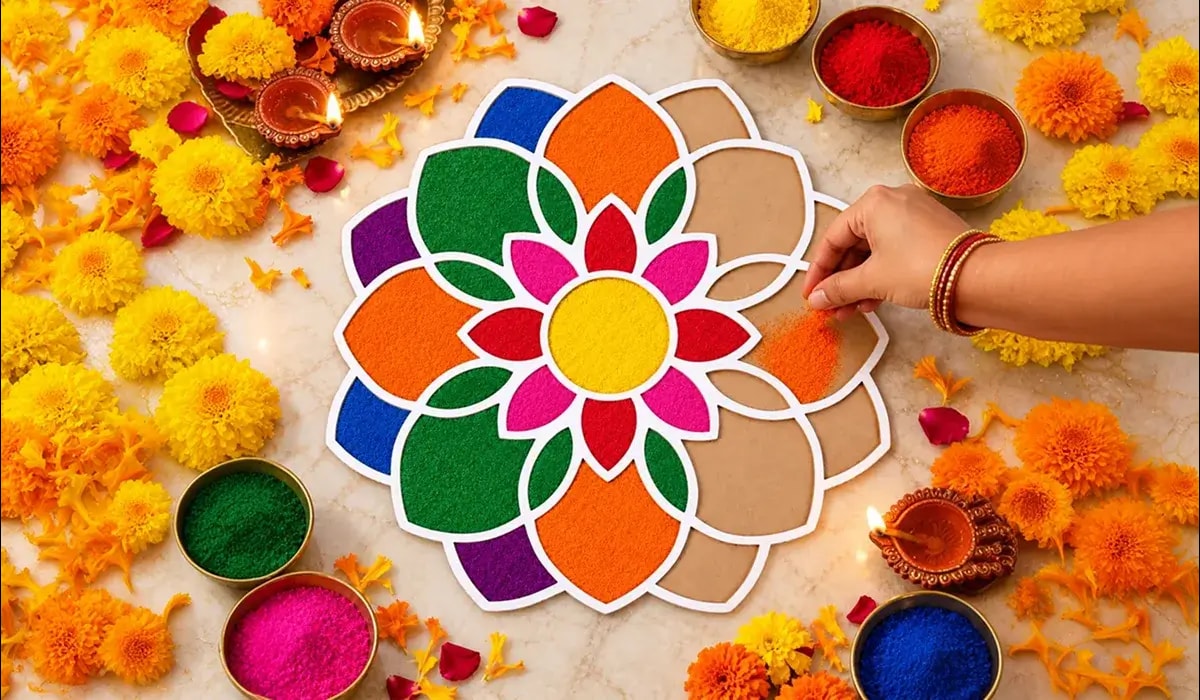
A rangoli design for Diwali welcomes Goddess Lakshmi, invites positive spiritual vibrations, and transforms plain home thresholds into colorful festive works of art. Whether you are a beginner looking for quick 5-minute stencil hacks, a student preparing a school Diwali project, or a homeowner decorating a spacious foyer with flower petals and brass diyas, choosing the right pattern makes festive preparation effortless.
Related Articles: Diwali Decoration Ideas: Lights, Kurta Themes & Decor | When is Diwali in 2026: Dates & Shubh Muhurat | Dhanteras Puja 2026: Muhurat & Vidhi | Happy Diwali Wishes 2026
Key Takeaways
- Traditional Diwali rangoli patterns symbolize prosperity, divine blessings, and auspicious hospitality for visiting guests.
- Beginner-friendly options like the 4-petal flower, concentric diya circles, and 5x5 dot Kolam require under 15 minutes.
- Eco-friendly flower rangolis (Pookkalam) made with marigold, rose, and jasmine petals leave zero chemical residue on marble floors.
- Kitchen tools like plastic spoons, bangles, bottle caps, and combs help create intricate symmetry without professional drawing skills.
- Illuminating outer borders with mustard oil earthen diyas or floating candles elevates flat color patterns into layered 3D displays.
Significance of rangoli during Deepavali
The word Rangoli originates from the Sanskrit term Rangavalli, which translates to rows of colors. Across different Indian states, this sacred floor art is known by regional names: Kolam in Tamil Nadu, Muggulu in Andhra Pradesh, Alpana in Bengal, Mandana in Rajasthan, and Chowkpurana in Uttar Pradesh.
During the five-day Deepavali festival, creating floor artwork at the main entrance serves three distinct purposes:
- Welcoming Goddess Lakshmi: Entrances adorned with clean, geometric patterns and lotus motifs are believed to attract wealth, good fortune, and spiritual peace.
- Harmonizing energy fields: Symmetrical sacred geometry (mandala patterns) creates a calming psychological effect on family members and visiting guests.
- Ecological hospitality: Traditionally, floor patterns were drawn using coarse dry rice flour, turmeric, and vermilion, providing natural food for ants, birds, and small creatures as an act of everyday kindness.
7 Popular rangoli design categories for beginners
You do not need formal artistic training to craft an eye-catching floor display. Here are seven popular pattern archetypes suited for apartments, courtyards, and puja mandir corners.
1. Four-petal geometric flower
This classic beginner design relies on simple circles and teardrop shapes. Draw a small central coin circle, surround it with four uniform petals pointing north, south, east, and west, and enclose the flower within a larger circle. Fill alternating quadrants with contrasting hues like yellow and violet or crimson and mint green.
2. Diya and flame centerpiece
The diya rangoli places a large ceremonial oil lamp at the core. Sketch a wide bowl base, add a pointed flame tip above the rim, and radiate concentric teardrop lines outward. Accentuate the finished drawing by placing a lit brass or terracotta diya directly on the painted flame.
3. Dot-grid Kolam (5x5 or 7x4)
Grid-based patterns offer guaranteed symmetry. Place five rows of five chalk dots spaced two inches apart. Join adjacent dots using straight diagonal lines or looping curves to form stars, interlocking knots, or floral vines. This style suits compact apartment doorsteps where space is limited.
4. Lotus bloom (Lakshmi Kamal)
The lotus is the sacred seat of Goddess Lakshmi, symbolizing purity and abundance amidst worldly challenges. Draw eight curved petals around a central bud, using deep magenta, blush pink, and white accents on green base leaves.
5. Peacock feather and Mayur motif
Peacock designs add regal grace to verandas. A stylized side-profile peacock with an unfurled tail allows you to blend royal blue, emerald green, turquoise, and lemon yellow powders seamlessly.
6. Floral petal rangoli (Pookkalam style)
If you prefer a mess-free setup that cleans up in seconds, use natural flower petals. Deconstruct whole orange marigolds, yellow chrysanthemums, red rose petals, and green bilva or mango leaves. Arrange them in concentric rings around a central brass urli filled with floating candles.
7. Corner and border runners
When hallway space does not accommodate a large central circle, border rangolis provide an elegant solution. Run repeating floral creepers, conch shell (shankha) shapes, or zigzag diya motifs along the skirting tiles of hallways and thresholds.
Comparison of rangoli mediums and materials
Selecting the right materials depends on floor type, child safety, and cleanup convenience:
| Medium | Best for | Durability | Cleanup effort | Eco-friendly rating |
|---|---|---|---|---|
| Coarse marble powder colors | Outdoor courtyards, verandas | High (wind resistant) | Moderate (sweep or vacuum) | Good |
| Fresh flower petals | Indoor marble, wooden floors | 1 to 2 days | Very easy (scoop and compost) | Excellent (100% biodegradable) |
| Rice flour and turmeric | Mandir steps, daily Kolam | 1 day | Easy (wipe with damp cloth) | Excellent |
| Colored sawdust / wood powder | Large public festival venues | Moderate (lightweight) | Moderate | Moderate |
| Acrylic stencil cutouts | Last-minute apartment decor | Reusable for years | Zero mess | Non-biodegradable |
Step-by-step instructions to create an easy Diwali rangoli
Follow these structured steps to draw a symmetrical floral diya rangoli in under 20 minutes.
Clean and prepare the floor surface
Sweep the entryway and wipe it down with a damp cotton cloth. Ensure the surface is bone-dry before sketching, as moisture causes dry powders to clump and bleed.
Sketch the guiding outline with white chalk
Use a standard school chalk stick or a compass to mark a circular boundary (approximately 18 to 24 inches in diameter). Lightly sketch a central diya bowl, surrounded by six or eight radiating floral petals.
Draw clean white borders
Using dry rice flour or white marble powder, pinch a small amount between your thumb and index finger. Move your hand steadily along the chalk outlines to form distinct, raised boundary walls.
Fill colored powders from inner core to outer edges
Work from the center outwards to avoid smudging previously filled areas with your wrists or elbows. Fill the central flame with yellow and orange, the lamp body with royal blue, and outer petals with contrasting ruby red and bottle green.
Add final texture and light up real diyas
Use a plastic bottle nozzle, a clean fork, or earbud tips to swirl spiral textures into the petal powder. Complete the artwork by placing mustard oil earthen lamps or floating tealights along the outer rim.
5 Creative household hacks for perfect symmetry
You do not need expensive specialized equipment to achieve crisp circles and uniform lines. Everyday household items make exceptional rangoli tools:
- Stainless steel bangles: Place bangles directly on the floor as stencils to fill tiny, flawless colorful circles inside larger petal frames.
- Plastic spoons: Gently press the rounded back of a spoon into powder heaps to form neat textured scallops and flower veins.
- Empty squeeze bottles: Clean sauce dispensers or hair dye bottles filled with colored powder allow you to draw sharp lines like a pen.
- Wide-tooth combs: Dragging a plastic comb through dual-color powder layers creates professional striped gradient waves.
- Paper cone funnels: Roll a small square of cardstock into a narrow funnel for targeted, spill-free dot placement.
Color symbolism and festive palette guide
Traditional Indian floor art relies on intentional color harmonies that carry cultural and spiritual meaning:
| Color | Cultural symbolism | Recommended combinations |
|---|---|---|
| Bright Yellow & Gold | Knowledge, optimism, sunshine, and prosperity | Paired with royal purple or navy blue |
| Deep Red & Vermilion | Auspiciousness, fertility, and marital bliss | Paired with crisp white rice powder |
| Emerald Green | Renewal, nature, peace, and abundance | Paired with sunflower yellow or bright orange |
| Royal Blue & Cyan | Infinite sky, cosmic depth, and tranquility | Paired with warm marigold orange |
| Pure White | Cleanliness, peace, and divine illumination | Used as universal boundary divider |
Essential safety, placement, and maintenance tips
To keep your festive artwork pristine throughout Lakshmi Puja evening, follow these practical guidelines:
- Avoid high-traffic walk lines: Position central floor art slightly off the direct entryway walking path so guests do not inadvertently step over the artwork.
- Beware of ceiling fans and drafty doors: If decorating indoors, turn off high-speed overhead fans until the powder settles, or use flower petals which resist drafts better than lightweight powder.
- Child and pet safety: Avoid artificial chemical powders containing glass powder or industrial dyes. Opt for food-grade colors, turmeric, beet juice powder, and natural petals if toddlers or pets share the house.
- Firm placement for lit oil lamps: Ensure clay diyas placed on rangoli borders have flat bases and contain adequate oil so they burn steadily without tipping onto flower leaves.