
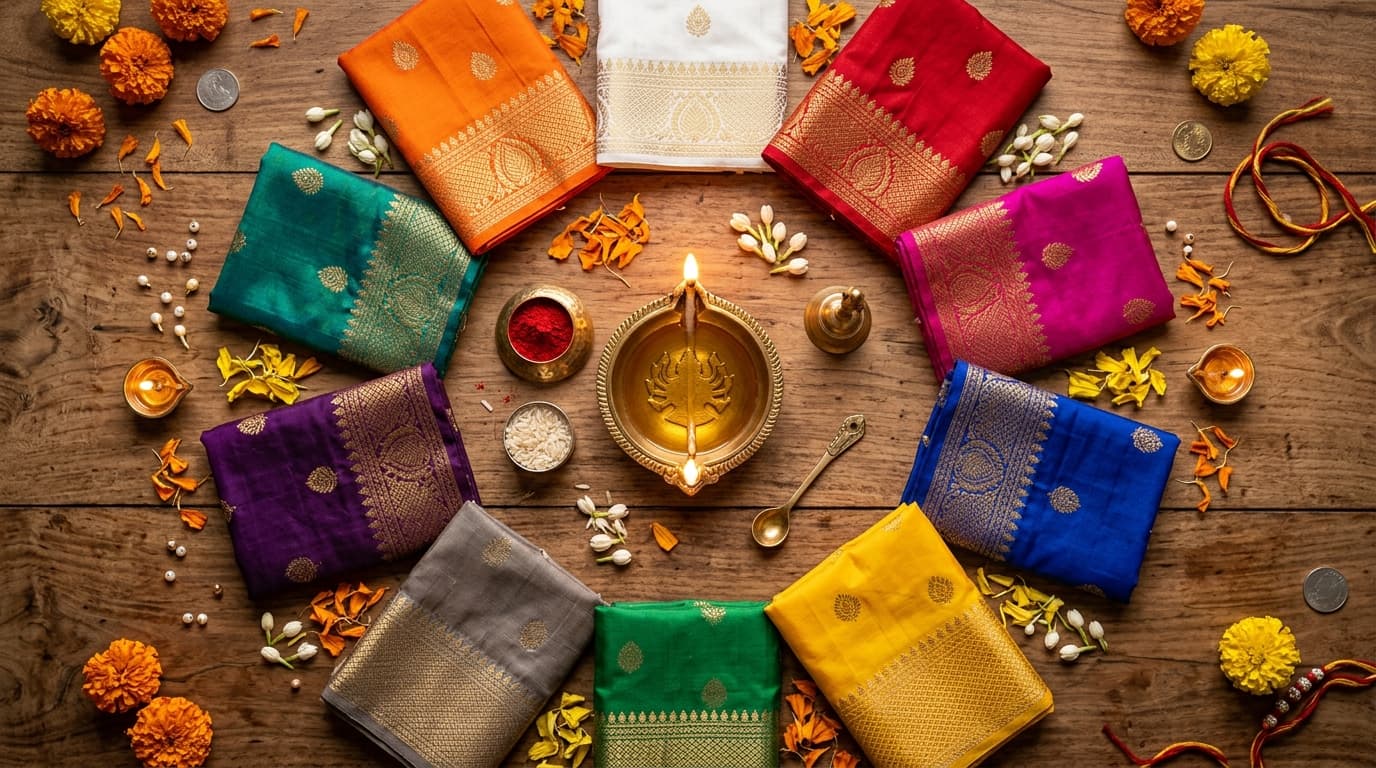
The vibrant nine nights of Navratri celebrate the triumph of divine feminine energy (Shakti) over darkness and negativity. Across homes, temples, and energetic Garba and Dandiya pandals in Gujarat, Maharashtra, and North India, devotees celebrate each sacred day by wearing a designated color dedicated to one of the nine divine manifestations of Goddess Durga (Navadurga).
Related Articles: Traditional Navratri Vrat Food & Fasting Recipes | Durga Puja Schedule & Mahalaya Guide | Festive Lehenga, Saree & Blouse Styling Guide | Festive Rangoli & Mehndi Design Ideas
Navratri 9 Colors at a Glance
- Day-Wise Color Sequence: Orange (Day 1), White (Day 2), Red (Day 3), Royal Blue (Day 4), Yellow (Day 5), Green (Day 6), Grey (Day 7), Purple (Day 8), and Peacock Green (Day 9).
- Astrological Alignment: Each color corresponds to a ruling planet (Graha), bodily Chakra, and specific form of Maa Durga from Shailaputri to Siddhidatri.
- Bhog & Prasadam: Dedicated sacred offerings range from pure desi cow ghee on Pratipada to traditional halwa-puri-chana on Maha Navami Kanya Pujan.
- Festive Dress Code: Devotees, families, and office colleagues coordinate their outfits daily to invoke positivity, harmony, and spiritual alignment.
What Are the Navratri 9 Colors and Their Significance?
The Navratri 9 colors represent the nine distinct divine manifestations of Goddess Durga (Navadurga) celebrated across the nine-day Hindu festival. Devotees wear a designated color each day—ranging from energetic orange on Pratipada to auspicious peacock green on Navami—to align their mind, body, and spiritual vibrations with universal cosmic energy and seek Devi's blessings.
Wearing specific colors during Navratri is not merely an aesthetic choice; it is an ancient practice grounded in Vedic astronomy, color therapy, and spiritual resonance. Each color corresponds to a specific day of the week, ruling planetary deity, and bodily Chakra, channeling specific virtues such as courage, serenity, devotion, and compassion.
| Navratri Day & Tithi | Maa Durga Avatar | Designated Color | Spiritual Meaning | Sacred Bhog (Prasad) | Ruling Planet |
|---|---|---|---|---|---|
| Day 1 (Pratipada) | Maa Shailaputri | Orange | Energy, vitality & courage | Pure Cow Ghee | Moon (Chandra) |
| Day 2 (Dwitiya) | Maa Brahmacharini | White | Purity, peace & penance | Sugar (Shakkar) & Panchamrit | Mars (Mangala) |
| Day 3 (Tritiya) | Maa Chandraghanta | Red | Fearlessness & divine grace | Milk Sweets & Kheer | Venus (Shukra) |
| Day 4 (Chaturthi) | Maa Kushmanda | Royal Blue | Cosmic power & tranquility | Malpua | Sun (Surya) |
| Day 5 (Panchami) | Maa Skandamata | Yellow | Joy, intellect & maternal love | Banana & Yellow Fruits | Mercury (Budha) |
| Day 6 (Shashthi) | Maa Katyayani | Green | Renewal, growth & fertility | Raw Honey (Madhu) | Jupiter (Brihaspati) |
| Day 7 (Saptami) | Maa Kalaratri | Grey | Stoic strength & protection | Jaggery (Gud) | Saturn (Shani) |
| Day 8 (Ashtami) | Maa Mahagauri | Purple | Grandeur, royalty & wisdom | Fresh Coconut | Rahu |
| Day 9 (Navami) | Maa Siddhidatri | Peacock Green | Fulfillment of desires (Siddhis) | Halwa, Poori & Chana | Ketu |
Day-by-Day Guide: Navratri 9 Colors, Goddess Avatars & Rituals
Day 1: Pratipada – Maa Shailaputri (Color: Orange)
Maa Shailaputri is the first manifestation of Goddess Durga, celebrated on Pratipada after the sacred Ghatasthapana (Kalash Sthapana) ritual. Born as the daughter of the King of the Himalayas (Himavat), she rides a bull (Nandi) holding a trident (Trishul) and a lotus flower. She governs the Muladhara (Root) Chakra, representing grounding, new beginnings, and stability.
- Color Significance: Orange symbolizes warmth, enthusiasm, radiant dawn, and boundless spiritual energy. Wearing orange infuses the devotee with courage to overcome worldly challenges.
- Sacred Bhog: Offer pure cow desi ghee at the feet of Maa Shailaputri to seek freedom from illness, physical vitality, and longevity.
- Beej Mantra:
ॐ देवी शैलपुत्र्यै नमः(Om Devi Shailaputryai Namah) - Outfit & Styling: A vibrant tangerine or rust-orange silk saree, bandhani dupatta, or orange kurta-pyjama with antique gold or brass jewelry. Pair with traditional sweets from our Indian Festival Recipes Guide.
Day 2: Dwitiya – Maa Brahmacharini (Color: White)
Maa Brahmacharini is the ascetic form of Goddess Durga, who undertook thousands of years of rigorous penance (tapasya) to attain Lord Shiva as her consort. Depicted walking barefoot with a rosary (Japamala) in her right hand and a water pot (Kamandalu) in her left, she governs the Swadhisthana Chakra and bestows immense restraint, wisdom, and emotional control.
- Color Significance: White represents unblemished purity, calm, honesty, and spiritual devotion. Wearing white clears mental clutter and cultivates inner peace.
- Sacred Bhog: Offer white granulated sugar (shakkar), mishri, or panchamrit to ensure family prosperity and emotional stability.
- Beej Mantra:
ॐ देवी ब्रह्मcharinyai Namah(Om Devi Brahmacharinyai Namah) - Outfit & Styling: Pristine ivory chanderi sarees, off-white Chikankari kurtas, or white linen kurtas paired with freshwater pearl necklaces or silver oxidised studs.
Day 3: Tritiya – Maa Chandraghanta (Color: Red)
Maa Chandraghanta represents the married and fierce warrior aspect of the Goddess. Adorned with a crescent moon shaped like a bell (ghanta) on her forehead, she possesses ten arms holding divine weapons and rides a mighty tiger. She governs the Manipura (Solar Plexus) Chakra, removing fear and infusing the devotee with bravery.
- Color Significance: Red is the universal color of Shakti—symbolizing fiery passion, fierce protection, auspiciousness, and unmatched strength.
- Sacred Bhog: Offer kheer, rabdi, or condensed milk sweets to dissolve sorrow and grant inner harmony.
- Beej Mantra:
ॐ देवी चन्द्रघण्टायै नमः(Om Devi Chandraghantayai Namah) - Outfit & Styling: A rich vermillion or crimson Banarasi silk saree, red Anarkali suit, or red Nehru jacket. Check our Festive Lehenga & Saree Styling Guide for elegant necklines and accessories.
Day 4: Chaturthi – Maa Kushmanda (Color: Royal Blue)
Maa Kushmanda is the cosmic creator who illuminated the dark void with her gentle, radiant smile, initiating the universe (Brahmanda). Residing in the solar core, she has eight arms holding sacred weapons and a jar of nectar (Amrit), seated majestically on a lion. She governs the Anahata (Heart) Chakra.
- Color Significance: Royal Blue represents vastness, cosmic intelligence, regal grace, and profound serenity like the deep midnight sky.
- Sacred Bhog: Offer Malpua (sweet syrup-soaked pancakes) to enhance decision-making capacity, intellect, and memory power.
- Beej Mantra:
ॐ देवी कूष्माण्डायै नमः(Om Devi Kushmandayai Namah) - Outfit & Styling: Deep royal blue raw silk lehenga, indigo handloom saree, or navy ethnic bandhgala paired with statement silver temple jewelry.
Day 5: Panchami – Maa Skandamata (Color: Yellow)
Maa Skandamata is the motherly avatar who holds the infant Lord Kartikeya (Skanda), the commander-in-chief of the celestial army, on her lap. Depicted with four hands seated on a lotus (Padmasana), she governs the Vishuddha (Throat) Chakra, bringing articulacy, creative expression, and intellectual brilliance.
- Color Significance: Yellow signifies joy, optimism, warmth, and sunshine. It dispels depression, fatigue, and lethargy from one's mind.
- Sacred Bhog: Offer fresh bananas or seasonal yellow fruits to protect the family from chronic illnesses and physical ailments.
- Beej Mantra:
ॐ देवी स्कन्दमात्रे नमः(Om Devi Skandamatayai Namah) - Outfit & Styling: Sunny yellow mirror-work chaniya choli for evening Garba, mustard yellow silk kurta, or floral yellow organza saree with delicate kundan ornaments.
Day 6: Shashthi – Maa Katyayani (Color: Green)
Maa Katyayani was manifested from the collective radiant energies of Brahma, Vishnu, and Shiva to eliminate the demon king Mahishasura. Born to the sage Katyayana, she rides a fierce lion wielding a gleaming sword. She governs the Ajna (Third Eye) Chakra, granting keen intuition, victory over rivals, and marital harmony.
- Color Significance: Green symbolizes fertile renewal, life, tranquility, nature, and prosperous growth.
- Sacred Bhog: Offer pure raw forest honey (Madhu) to invoke beauty, personal charisma, and sweetness in domestic life.
- Beej Mantra:
ॐ देवी कात्यायन्यै नमः(Om Devi Katyayanyai Namah) - Outfit & Styling: Emerald green Kanjeevaram saree, olive green tiered gown, or bottle-green pathani suit accented with emerald or jade drop earrings.
Day 7: Saptami – Maa Kalaratri (Color: Grey)
Maa Kalaratri is the most ferocious manifestation of Goddess Durga. With dark ebony skin, disheveled hair, three luminous eyes, and blazing necklaces, she is the destroyer of darkness, ignorance, and malevolent spirits. Despite her fearsome appearance, her right hands grant boons and protection, earning her the name Shubhankari (the benevolent one). She governs the Sahasrara (Crown) Chakra.
- Color Significance: Grey represents balanced neutrality, stoic maturity, and the power to destroy negative influences without arrogance.
- Sacred Bhog: Offer jaggery (gud) or jaggery-infused sweets to ward off sudden misfortunes, financial crunches, and malefic astrological planetary influences.
- Beej Mantra:
ॐ देवी कालरात्र्यै नमः(Om Devi Kalaratryai Namah) - Outfit & Styling: Ash grey or charcoal handloom silk saree, silver-grey linen kurta, or metallic slate coordinates paired with oxidised chokers.
Day 8: Ashtami – Maa Mahagauri (Color: Purple)
Maa Mahagauri is the extraordinarily radiant and serene manifestation of Devi. Having performed intense austerity that darkened her skin, Lord Shiva bathed her with the holy waters of the sacred Ganga, restoring her complexion to gleaming white. Riding a white bull and holding a trident and damru, she cleanses devotees of all past karmic sins during Maha Ashtami.
- Color Significance: Purple symbolizes royal grandeur, deep spiritual wisdom, nobility, and divine grace.
- Sacred Bhog: Offer fresh coconut (nariyal) or coconut laddus to seek family well-being and blessings for childless couples.
- Beej Mantra:
ॐ देवी महागौर्यै नमः(Om Devi Mahagauryai Namah) - Outfit & Styling: Rich magenta, plum, or royal purple Patola saree, embroidered bandhgala, and kundan or meenakari jewelry. Maha Ashtami is also celebrated alongside Durga Puja Maha Ashtami rituals.
Day 9: Navami – Maa Siddhidatri (Color: Peacock Green)
Maa Siddhidatri is the ultimate manifestation of Goddess Durga who bestows all eight supernatural accomplishments (Ashta Siddhis) and nine divine treasures (Nav Nidhi). Lord Shiva himself attained his Ardhanarishwara form by the grace of Maa Siddhidatri. Seated on a blooming lotus, she represents supreme fulfillment and cosmic oneness.
- Color Significance: Peacock Green (Mayur Pankhi Neel) combines the calming depth of blue with the vitality of green, representing supreme compassion, richness, and spiritual completion.
- Sacred Bhog: Offer the traditional Kanya Pujan prasad consisting of sooji halwa, poori, and black gram (kala chana) to young girls who embody the living forms of the Goddess.
- Beej Mantra:
ॐ देवी सिद्धिदात्र्यै नमः(Om Devi Siddhidatryai Namah) - Outfit & Styling: Dual-tone peacock teal silk saree, cyan embroidered kurta, or peacock green lehenga with traditional temple jewelry. Complete your festive look with ideas from our Festive Rangoli & Mehndi Designs.
How Are the 9 Colors of Navratri Decided Each Year?
The order of the 9 Navratri colors changes every year because the sequence is determined by the weekday on which the festival begins (Pratipada). In Vedic astrology, each day of the week is governed by a celestial planet, and the first day's color aligns with that ruling planet, following a continuous cyclical pattern for the remaining days.
The standard cyclical color allocation follows this astrological order:
- Sunday: Orange (Sun – Surya)
- Monday: White (Moon – Chandra)
- Tuesday: Red (Mars – Mangala)
- Wednesday: Royal Blue (Mercury – Budha)
- Thursday: Yellow (Jupiter – Brihaspati)
- Friday: Green (Venus – Shukra)
- Saturday: Grey (Saturn – Shani)
- Subsequent Days: Purple and Peacock Green (or Pink) to complete the 9-day cycle.
If Pratipada starts on a Thursday, the cycle begins with Yellow on Day 1, followed by Green on Friday, Grey on Saturday, Orange on Sunday, and so forth. In some calendar years where a Tithi is doubled (Vriddhi) or skipped (Kshaya), the color assignment is calibrated by astrologers so that all nine sacred colors are honored across the festival. For details on how Tithis interact with Hindu calendar months, consult our Hindu Calendar Months Guide.
Festive Fashion & Styling Guide: Coordinating Navratri Colors
Whether you are participating in late-night Garba in Ahmedabad, attending community Dandiya raas, or celebrating ethnic days at your workplace, here is how you can style your daily Navratri wardrobe effortlessly:
- Traditional Garba & Dandiya Nights: For high-energy folk dancing, choose breathable pure cotton or modal silk chaniya cholis and kedias featuring authentic Kutchi embroidery, mirror work, and cowrie shell trims. Contrast your primary day color with a vivid multi-colored dupatta.
- Workplace & Everyday Ethnic Styling: If you wish to join office color challenges, keep your attire smart and understated. Opt for solid-tone pastel or jewel-tone kurtas, khadi shirts, cotton sarees, or Nehru jackets matching the day's hue.
- Jewelry Coordination:
- Pair White, Grey, and Royal Blue with oxidised German silver or Afghan tribal jewelry.
- Pair Orange, Red, Yellow, and Green with warm antique gold, temple motifs, or kundan chokers.
- Pair Purple and Peacock Green with multi-colored Meenakari or pearl accessories.
Essential Ritual Dos and Don'ts for the 9 Days of Navratri
Maintaining spiritual discipline during Navratri amplifies the benefits of your prayers and fasting rituals:
- Do's:
- Wake up early, bathe, and wear fresh, unsoiled clothes in the designated day color before performing the morning aarti.
- Maintain the Akhand Jyoti (unbroken sacred oil lamp) with pure sesame oil or cow ghee throughout the nine days.
- Consume strictly satvik fasting foods such as buckwheat flour (kuttu), water chestnut flour (singhara), sabudana, and rock salt (sendha namak).
- Treat all women and young girls with utmost reverence, especially during Ashtami and Navami Kanya Pujan.
- Don'ts:
- Avoid wearing pure black clothing or accessories during puja rituals, as black absorbs negative energy and is considered inauspicious for Devi worship.
- Avoid haircuts, shaving, and nail trimming while maintaining the Akhand Jyoti at home.
- Strictly refrain from consuming onions, garlic, alcohol, non-vegetarian food, and packaged processed snacks.
- Never leave your house completely locked and unoccupied if an Akhand Jyoti is lit inside.